
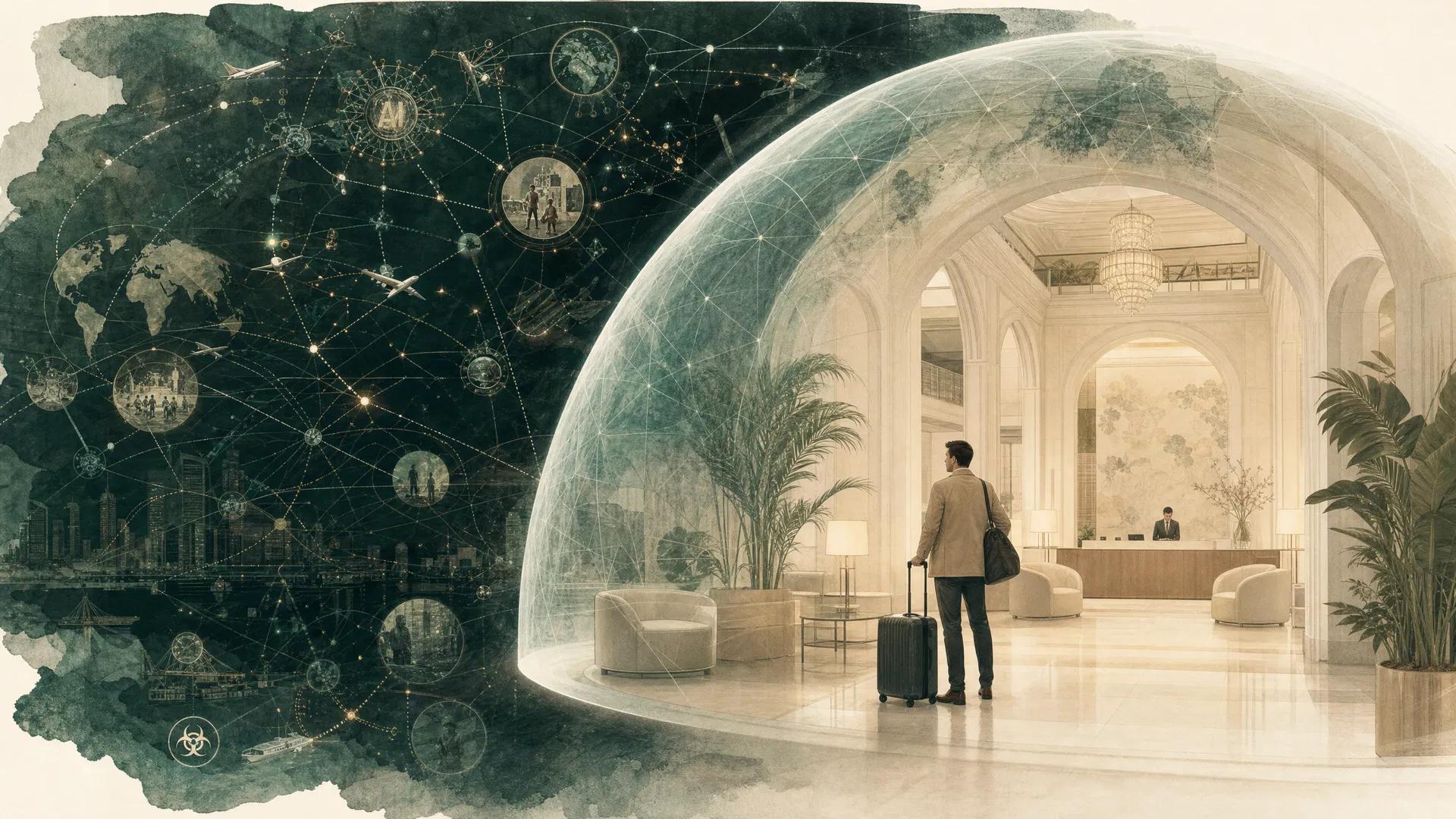
Global hospitality is entering a stage where visible luxury is no longer enough. The new competition will be protecting the guest's peace of mind before the risk becomes visible.
An invisible frontier between experience and peace of mind
For decades, hospitality believed it competed on what it could show. Today it is beginning to discover that it also competes on what it manages to control without the guest ever seeing it.
Spectacular lobbies. Architecture. Cuisine. Experiences designed to surprise. Entertainment. Luxury. For years, much of the hospitality conversation revolved around what could be photographed, sold and shared.
But while the industry kept perfecting the visible experience, the world began to change quietly around it.
Today, behind the global tourism operation, a new conversation is gaining strength: the management of invisible risks. We are not talking only about health. Nor only about technology. We are talking about something more complex: trust.
Between the visible experience and real peace of mind lies an invisible frontier. On one side is what the guest perceives. On the other, everything the operation must sustain so that perception does not break.
The modern guest no longer buys luxury alone. They are beginning to buy peace of mind.
The new complexity of the modern world
Artificial intelligence did not create the problem. It accelerated a reality that was already taking shape: a humanity with more technical power, more information speed, and not always enough maturity to understand the consequences of what it builds.
That is the real risk. Not technology in itself. The risk lies in the lack of human balance in the face of the power that technology multiplies.
The combination of artificial intelligence, biotechnology, global mobility and hyperconnectivity is creating an environment harder to interpret than the one we had just a decade ago. Specialized knowledge once belonged mainly to governments, universities, laboratories and large corporations. Today those barriers are beginning to fall.
The speed at which information circulates and artificial intelligence's capacity to process it are quietly altering the global balance. And when the world becomes more unpredictable, tourism becomes more vulnerable.
Because tourism depends on something extremely fragile: human perception.
«A guest does not need to understand a risk to react emotionally to it.»
The modern guest has learned to distrust quietly
After the past few years, the traveler has changed. They observe more. They ask more. They perceive more. Even when they do not technically understand an operational process, they can sense when an environment conveys order, control, stability, coherence and emotional calm.
They can also sense the opposite.
A disorganized breakfast, a tense lobby, an unsure reaction from the staff, improvised protocols or inconsistent cleaning can trigger an immediate emotional decision.
Because tourism has never depended on luxury alone. It depends on the emotional sense of safety. No one truly enjoys a trip when they sense things are out of control.
Modern luxury has begun to change quietly
Part of the industry still believes trust is solved with marble, a signature lobby scent and a well-trained smile. The modern guest, quietly, is already looking at something else.
The international premium traveler no longer buys exclusivity alone. They are beginning to buy peace of mind. That shift is far deeper than many hotels imagine.
There is a mistaken idea within the sector: believing that only tour operators are raising the bar on prevention, hygiene and operational control. The reality is more complex.
The premium traveler who books directly, uses private concierges, boutique agencies or exclusive platforms is already making decisions from another place: perception, discretion, stability, reputation, consistency and operational trust.
This guest does not need to fully understand a risk to react emotionally to it. When a hotel, a brand or a destination conveys vulnerability, the premium segment simply moves elsewhere. No conflict. No explanation. No noise.
«The new luxury will not only be what dazzles, but what protects.»
Biosecurity no longer belongs to the medical world alone
For years, many protocols were treated as mere operational requirements: forms, regulations, audits and compliance. But much of the industry still views prevention through a reactive mindset, and the world has already moved past that stage.
Today biosecurity is beginning to become reputational protection, operational continuity, commercial stability, emotional brand armor and quiet trust for guests and investors.
Because when a crisis hits, the market rarely remembers who had the most spectacular lobby. It remembers who conveyed control.
Trust is not improvised at the front desk. It is built earlier — in kitchens, water systems, rooms, protocols, maintenance, security, technology and decisions the guest will almost never know about.
«Trust is not improvised at the front desk.»
The new prevention cannot be seen, but it is felt
Guests rarely know the internal systems that sustain a high-level hotel operation. They do not see water controls, preventive monitoring, food-safety protocols, operational assessments, microbiological analyses or the management of invisible risks.
But they do perceive their effects. They are felt in the order, the consistency, the genuine cleanliness, the staff's response and the emotional calm of the environment.
The best prevention is precisely the kind the guest never needs to notice. Everything works before a problem appears.
That is where the difference begins between merely operating a hotel and truly caring for people.
«The best prevention is the kind the guest never has to notice.»
The invisible frontier
The invisible frontier is the line that separates what the guest sees from everything the tourism operation sustains in silence. It divides the visible experience from invisible risks, apparent luxury from real trust, perceived calm from silent prevention, and the commercial promise from the human experience.
Much of the future of hospitality is decided at that frontier. Because a memorable experience does not happen by accident. It is built with decisions, systems, standards, leadership, training and prevention.
When that invisible architecture works, the guest does not need to see it. They simply feel they can rest.
Tourism enters a new emotional stage
For decades the tourism conversation revolved around experience and service. The next stage will revolve around resilience, prevention, stability, perception and trust.
Tourism's next battle will not be over luxury alone. It will be over credibility.
Hotels that understand this before the rest of the market will hold an enormous advantage: greater stability, better international perception, more emotional value for premium guests, reputational protection and greater resilience against future crises.
The tourism of the future will probably not be defined by who offers the most spectacle, but by who manages to convey the most peace of mind in an increasingly unstable world.
«Tourism's next battle will not be over luxury alone. It will be over credibility.»
The real challenge is not technological. It is human.
Artificial intelligence, biotechnology and global hyperconnectivity will keep quietly transforming the international tourism industry. That has already begun.
But perhaps the real problem was never artificial intelligence. Perhaps the problem was always the human difficulty of wielding power without losing awareness, stability and meaning.
Technology merely accelerated something that already existed: a civilization increasingly powerful and, often, emotionally emptier.
In the middle of that scenario, tourism will face an entirely new challenge: making people feel safe again while the world grows more unpredictable.
Because in the new emotional economy of tourism, peace of mind is beginning to be worth more than spectacle.